


News
In NaUKMA, the Gender Equality Week 2026 took place
- Details
- Published on Tuesday, 29 September 2026 10:31
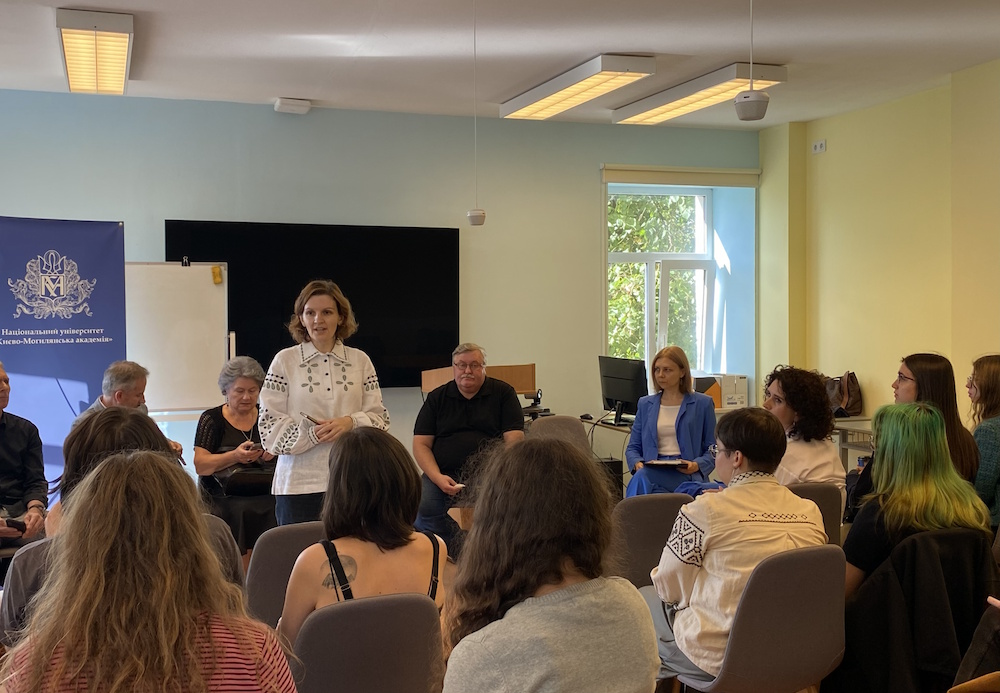
In the second week of September, NaUKMA hosted its annual event — the fourth consecutive Gender Equality Week — a joint effort organized by the Committee for Combating Discrimination, Sexual Harassment, and Bullying at NaUKMA, and the Department of Sociology at NaUKMA.
Despite ongoing concerns, the university community — students and faculty — gathered to listen and engage in discussions on current issues related to ensuring gender equality in Ukrainian society, especially during the period of the Russo-Ukrainian war. We sincerely thank everyone who contributed to organizing the events: the Faculty of Social Sciences and Social Technologies, the Volodymyr Morenets Department of Literary Studies, the Department of Philosophy and Religious Studies, the Department of Ukrainian Language, the Faculty of Humanities, the Student Affairs Office, the student organization “Feminist Student Organization of the Academy (FOSА),” KMA Alumni, and the “Smoloskyp” publishing house.
The opening of Gender Equality Week on September 7, 2026, was dedicated to the establishment of an interdisciplinary certificate program in gender studies at NaUKMA and the significance of Solomiya Pavlychko’s figure. NaUKMA President Serhiy Kvit opened the event with words of support and emphasized the importance of continuing the academic tradition at NaUKMA to study and research issues of equal rights and opportunities.
Tamara Martsenyuk, associate professor of the Department of Sociology, head of the Solomiya Pavlychko Certificate Program in Gender Studies and Chair of the Committee for Combating Discrimination, Sexual Harassment, and Bullying, spoke about the prerequisites for establishing the interdisciplinary certificate program in gender studies at NaUKMA. She highlighted student interest in gender-themed disciplines and the presence over recent decades of various courses across multiple departments that should be integrated. Dr. Svitlana Oksamytna, a professor of sociology and founder of gender sociology at NaUKMA, recalled the introduction of the mandatory course “Introduction to Gender Studies,” which has been successfully taught and chosen by students from other departments for nearly 30 years. Olha Poliukhovych, a member of the Committee for Combating Discrimination, Sexual Harassment, and Bullying at NaUKMA, Vice President for Research and Academic Affairs, PhD in Philology, and associate professor of the Volodymyr Morenets Department of Literary Studies, skillfully moderated the meeting, sharing memories of Solomiya Pavlychko from the well-known book “Feminism” (Osnovy, 2002), published in her honor.
Roman Veretelnyk, PhD in Slavic Studies, associate professor and head of the Volodymyr Morenets Department of Literary Studies, shared his memories of Solomiya Pavlychko, who began teaching at the Department of Literary Studies in the mid-1990s. Dmytro Mazin, candidate of Philology, dean of the Faculty of Humanities, was among Pavlychko’s students at that time and noted her bold teaching style during lectures on literary theory. Another student of Pavlychko, Rostyslav Semkiv, candidate of Philology, associate professor of the Volodymyr Morenets Department of Literary Studies, and director of “Smoloskyp” publishing, highlighted the importance of her 1997 book “Discourse of Modernism in Ukrainian Literature,” which quickly became a scientific bestseller in Ukraine. Nataliia Peleshenko, a candidate of Philology and senior lecturer at the Volodymyr Morenets Department of Literary Studies, also shared warm memories of Solomiya Pavlychko. In conclusion, Olha Poliukhovych emphasized the importance of continuing and developing the intellectual tradition of teaching gender studies at NaUKMA, which was reflected in the establishment of the new interdisciplinary certificate program in gender studies at NaUKMA.
More about the Solomiya Pavlychko Chair of Gender Studies — on the NaUKMA website
On Tuesday, September 8, 2026, discussions focused on women’s access to military education, viewed through the lens of successes and challenges in ensuring gender equality. Tamara Martsenyuk, researcher of women’s status in military education and developer of the course “Gender-Sensitive Military Leadership” for military educational institutions and units, stated: “Ensuring women’s access to military education is a crucial factor in the successful integration of women into the security and defense sector as a labor market.” With many years in the higher military education system, Hanna Honcharenko, PhD in Law, professor at the National Security Service of Ukraine, and sister of the Kyiv-Mohyla Club, shared her thoughts on gender equality issues. She noted that despite formal access for women to all military educational institutions, barriers remain in admission, training, and employment in the security and defense sector. It is important to have more role models of women, better anti-discrimination and anti-sexual harassment policies, and increased media attention to higher military education. Maryna Lazarenko and Hanna Hrytsenko from the NGO “Institute of Gender Programs” (which has been implementing the research and advocacy project “Invisible Battalion” for many years) discussed the importance and results of the project on gender-sensitive military leadership in Ukrainian military education institutions. Sofiia Kviat, an alumna of the sociology bachelor’s program at NaUKMA and researcher on women’s access to military education, shared her bachelor’s thesis results on “Involving Women in Military Education in Ukraine.” Guests also included representatives from military educational institutions and UN Women, interested in the research findings and participating in discussions on what else can be done to improve women’s integration into military education.
On Wednesday, September 9, a discussion was held on the feminist anthology “Female Philosophers,” translated and edited by Veronika Puhach, a graduate of the Department of Philosophy and Religious Studies at NaUKMA, and Stefania Sidorova, a graduate student of the same department. The event was moderated by Tamara Martsenyuk, a teacher of the elective course “Feminism as a Social Theory and Social Movement” within the Solomiya Pavlychko Chair of Gender Studies. She noted the lack of feminist philosophy disciplines at NaUKMA and in Ukraine generally. The anthology “Female Philosophers,” which includes translated texts by notable women from the 17th–19th centuries (such as Sojourner Truth, Harriet Taylor Mill, Harriet Martineau, Frances Power Cobbe, Margaret Cavendish, Mary Shepherd), aims to fill this gap in academic knowledge. Veronika Puhach and Stefania Sidorova discussed the ideas behind these works, the challenges of translating such texts, and the need for greater attention to feminist themes in philosophy. Olha Ivashchenko, PhD in Philosophy and associate professor at the Faculty of Sociology at Taras Shevchenko National University of Kyiv, who also served as the scientific editor of the “Anthology of Feminist Philosophy” published in 2006 by the Solomiya Pavlychko Foundation “Osnovy,” shared insights about the translation challenges faced 20 years ago and today.
On Thursday, September 10, a presentation and discussion of the document “Gender-Sensitive and Non-Discriminatory Language at Kyiv-Mohyla Academy: Developing and Discussing Recommendations” took place. Tamara Martsenyuk, the initiator of the document and coordinator of the student research group (within the “Gender and Politics” course), explained the idea that arose at one of the Ministry of Education and Science conferences. The Strategy for Implementing Gender Equality in Education by 2030 states that educational documentation should be developed with consideration of non-discriminatory language principles, including strategies of feminization, neutralization, and avoiding androcentrism and sexism. It turned out that no Ukrainian higher education institution had developed such guidelines yet, despite expectations since 2022. Sociology students Daria Nedashkivska and Kateryna Hild presented the research team’s work on the “Gender-Sensitive and Non-Discriminatory Language at Kyiv-Mohyla Academy: Developing and Discussing Recommendations.” Tamara Martsenyuk thanked everyone involved in reviewing the recommendations: Olena Dotsenko, PhD in Philology, associate professor of Ukrainian language at NaUKMA; the Committee for Combating Discrimination, Sexual Harassment, and Bullying at NaUKMA; Olena Kharchenko, PhD in Law, associate professor at Yaroslav Mudryi National Law University and gender advisor to the Minister of Education and Science of Ukraine (2023–2026); Olena Synchak, associate professor of the Department of Philology at the Ukrainian Catholic University. The event moderator, Ada Krasenko, a graduate of NaUKMA’s sociology master’s program, head of the Student Affairs Department, and member of the Committee for Combating Discrimination, Sexual Harassment, and Bullying at NaUKMA, shared her experience using using feminine grammatical gender in official communication when gender-sensitive language is absent in the university’s staffing. From the university administration, Vice President for Research and Academic Affairs Olha Poliukhovych emphasized the importance of this document and noted that university documentation is one of the areas of implementing principles of equality and non-discrimination.
The last day of Gender Equality Week, Friday, September 11, was dedicated to a no less relevant topic for Ukrainian society and academic studies — Women in Politics and Activism: Challenges of the Russo-Ukrainian War. Daryna Zavgordnia, graduate of the Department of Sociology at NaUKMA and participant in the GRÓ GEST (Gender Equality Studies and Training Program) at the University of Iceland, and Iryna Tyshko, graduate of the master’s program in Public Governance at NaUKMA, PhD student in the Department of International Relations, and leader of the NGO “Civic Alliance ‘Women’s Political Action,’” presented the results of their research “The Impact of Russia’s Full-Scale War on Women’s Political Participation in Ukraine” for the NaUKMA community for the first time.
Quantitative data from the study indicates that the gender composition of local councils remains stable: on average, 37% women and 63% men. This stability is explained by the current mechanisms for replacing female deputies and gender quotas, which were mandatory in the last local elections. The qualitative analysis revealed two levels of factors influencing women’s decisions to resign from their mandates: structural factors — such as restrictions on crossing borders for local council deputies during the full-scale Russian invasion until September 2025, and expanded powers of military administrations; and individual factors — such as “breaking points,” including political pressure, accumulated fatigue combined with vulnerable financial situations, and reevaluation of mandates as tools for real influence. In all cases, decisions to resign were deliberate, based on personal priorities and assessments. The findings also suggest that stepping out of formal politics does not necessarily indicate a loss of political agency or interest in the political sphere overall. These results will soon be published in Ukrainian and in an English-language article in the professional sociological journal of the Department of Sociology, “NaUKMA Research Papers. Sociology.”
Zoryana Skaletska, member of the Committee for Combating Discrimination, Sexual Harassment, and Bullying at NaUKMA, associate professor at the Faculty of Law at NaUKMA, Ukraine’s Minister of Health in 2019–2020, and Kyiv City Council deputy, commented on the findings, drawing on her extensive experience in Ukrainian politics. She emphasized the importance of political leadership, support among women, and professionalism as key components of successful work in politics.
Values of equal rights and opportunities are a longstanding tradition at NaUKMA, where many events on this topic take place. As Tamara Martsenyuk summarized at the closing of the series: “Such educational and academic events, which implement state policy (the Strategy for Implementing Gender Equality in Education until 2030), aim to promote awareness and knowledge about the successes and challenges of achieving gender equality in Ukrainian society. Gender Equality Week has already become a good annual tradition within our university. This important event unites the NaUKMA community around relevant issues, including during wartime, for dialogue, solution-seeking, and continuous development.”
We look forward to seeing you at Gender Equality Week 2027 at the beginning of the next academic year!
Photos from the opening of the Week
Photos: Serhiy Rossinskyi, Tina Shchaslyva